
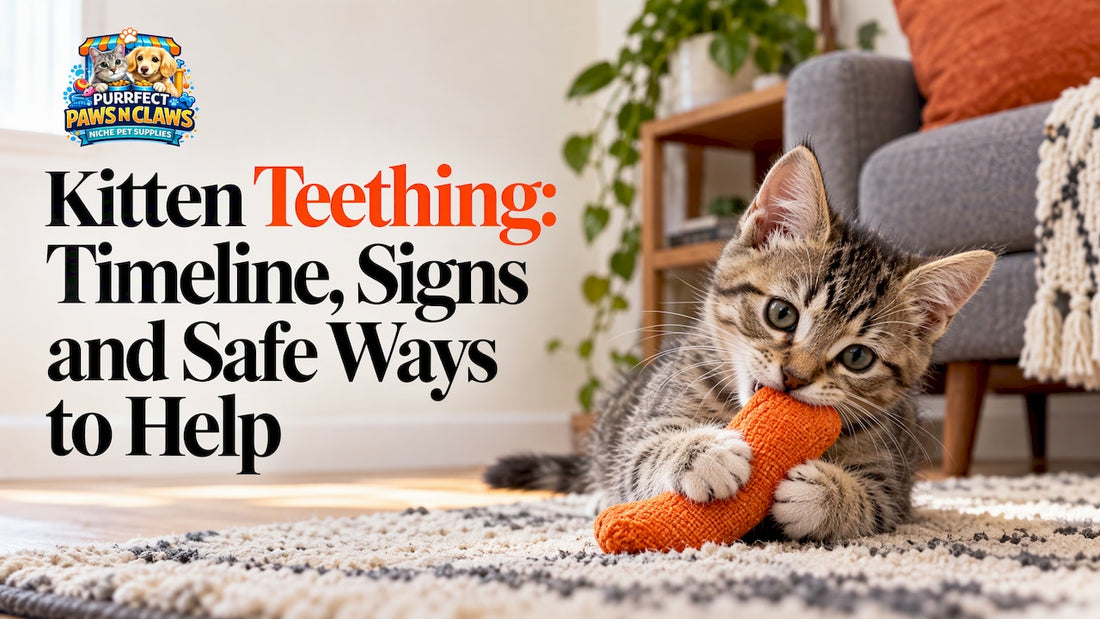
Kitten teething usually starts around 3 to 4 months of age and wraps up by about 6 months, when a full set of 30 adult teeth is in. During those weeks your kitten may chew more, drool a little and be cranky about their mouth. For most kittens this is a mild phase. What you can control is what ends up between those teeth: soft, supervised chew toys keep tiny teeth and your furniture, cords and fingers out of trouble. This guide covers the timeline, the signs, what actually soothes sore gums, how to pick a safe toy, and when a vet visit is the right call.
TL;DR
- Baby teeth come in at 2 to 8 weeks. They are replaced by adult teeth from about 3½ months, and the adult set is complete around 6 months (some kittens take until 7).
- Signs include extra chewing, drooling, pawing at the mouth, fussy eating and baby teeth turning up on the floor. Most kittens swallow them, which is harmless.
- Offer soft, flexible chew toys and a chilled, damp washcloth. Skip anything you cannot dent with a fingernail, plus ice, bones, antlers, cords and toys with small parts.
- Call your vet if your kitten stops eating, bleeds a lot, has very swollen gums, or still has baby teeth once the adult teeth are in.
Table of Contents
- The kitten teething timeline
- Signs your kitten is teething
- Does teething hurt?
- How to relieve a teething kitten
- Do kittens need teething toys?
- What to keep away from a teething kitten
- Picking toys for a teething kitten
- When to call the vet
- FAQ
- Sources
The kitten teething timeline
Kittens are born without teeth. According to PetMD’s kitten teething guide, a kitten has 26 baby teeth (also called milk or deciduous teeth): 12 incisors, 4 canines and 10 premolars. Adults have 30, because 4 molars join the set. Baby teeth are smaller, sharper and more translucent than the adult ones.
| Age | What is happening |
|---|---|
| 2 to 4 weeks | Baby incisors (the small front teeth) appear |
| 3 to 4 weeks | Baby canines (the fangs) come in |
| 4 to 6 weeks | Baby premolars arrive |
| By 8 weeks | All 26 baby teeth are in |
| 3½ to 4 months | Baby incisors are pushed out by adult incisors |
| 4 to 5 months | Canines and premolars are replaced |
| About 6 months (5 to 7) | All 30 adult teeth are present |
The timing comes from PetMD. The Merck Veterinary Manual agrees on the overall picture, noting that permanent teeth begin appearing around 4 to 7 months. Individual kittens run a little ahead or behind, so treat the ages as a range.
The part owners usually mean by “teething” is the second round, when adult teeth push out the baby ones. VCA Animal Hospitals describes it as roughly two to three months of change, and chewing habits can linger for months afterward.
Signs your kitten is teething
The signs are subtle, and many owners miss them entirely. PetMD lists these:
- Discomfort around the face: pawing or rubbing at the mouth, or general crankiness.
- Trouble with food: eating more slowly or dropping kibble.
- Drooling.
- “Kitten breath”: noticeably stronger breath.
- A new urge to chew, especially on soft things.
Zoetis Petcare adds head shaking, avoiding face contact and changes in grooming to the list.
You might also find a tiny, rice-sized tooth on the carpet or beside the food bowl. Most kittens swallow their baby teeth, and VCA notes this is very common and harmless. A little pink staining on a chew toy is usually fine too.
What about cat quidding?
Quidding is when a cat drops food from the mouth while chewing. In a kitten, a bit of dropped kibble can simply mean sore gums. If it continues after the adult teeth are in, or comes with drooling and bad breath, mention it to your vet.
Does teething hurt?
For the most part, not much. The Cat Fanciers’ Association, citing a veterinarian, says teething isn’t painful for the most part. Dr. Melody Conklin of Zoetis Petcare says much the same, but adds that kittens handle discomfort differently from one another. So a few kittens are plainly bothered while others sail through.
The practical takeaway: expect mild annoyance, offer relief, and watch for big changes. A kitten who suddenly won’t eat or whose personality changes noticeably deserves a call to the vet, covered below.
How to relieve a teething kitten
The goal is something gentle to chew and something cool on the gums. Here is what vets and veterinary groups suggest.
Chill a washcloth
This is the most repeated tip, and it costs nothing. Wet a clean washcloth, wring it out and chill it. PetMD suggests freezing it until it is “crunchy”, while the CFA says about half an hour in the freezer works. Vetster recommends a damp cloth that is refrigerated rather than fully frozen, because rock-hard items can be too tough on small teeth. A cloth that is cold and slightly firm, but still gives when pressed, is the safe middle ground. Stay with your kitten while they chew it, and take the cloth away when it starts to fray.

Offer a soft chew
Look for soft rubber, fabric or silicone. New England Animal Hospital suggests rubber or soft plastic kitten chew toys, and some can be cooled in the refrigerator for extra relief. VCA adds that toys or treats can be frozen to ease inflammation, but keep that to soft items you can still dent.
Play gently
The CFA recommends avoiding rubbing or petting the mouth and face area during this phase, and playing more gently. Zoetis says to put off brushing your kitten’s teeth until teething is done, then have a vet do an oral exam.
Redirect, don’t tug
If your kitten has something unsuitable in their mouth, offer a swap instead of pulling it out. Dr. Conklin cautions that grabbing or tugging a toy from a kitten’s mouth can cause pain.
Do kittens need teething toys?
Kittens do not need special teething toys the way puppies often do, and some vets call them optional. But a teething kitten is going to chew something, and a toy you chose is better than a phone charger or your knuckles. Chewing is natural, and VCA advises giving kittens appropriate things to chew on.
The practical value of toys is redirection. When the urge hits, your kitten has an acceptable target. Rotating a few toys also helps, since Cornell’s Feline Health Center recommends rotating toys to prevent boredom.

The fingernail test
The most useful rule for judging a chew toy is simple: press a fingernail into it. VCA advises choosing chew toys with a little bend, ones you can indent with a fingernail. Anything harder, such as nylon, risks fracturing teeth. Vetster uses the same test for rubber teething rings.
A safe teething toy checklist
- Soft and flexible: it gives when pressed and bends easily.
- Soft textures: Lane Veterinary recommends soft rubber, fabric or silicone, and textured rings or ridges for gum stimulation.
- No loose parts: skip strings, beads, bells or glued-on eyes that could come off. Lane Veterinary and Cornell both flag these.
- No feathers or strands: Cornell advises avoiding linear, strand-like parts that can separate and be swallowed.
- Right size: big enough that it can’t be swallowed whole, small enough to carry.
- Checked often: VCA and Hill’s both say to throw away any toy that is breaking apart or missing pieces. New England Animal Hospital says to discard broken pieces immediately because they are a choking hazard.
- Supervised: chew time is play time with you nearby.
What to keep away from a teething kitten
Some items cause real harm, and these are the ones to remove from reach.
- Electrical cords. VCA lists these among the things to avoid because of the shock risk. Zoetis suggests protecting cords and wires, and says double-sided pet tape can deter chewing.
- String, ribbon, yarn, hair ties, dental floss and rubber bands. Buda Veterinary Care warns that these can cause life-threatening intestinal blockages that need emergency surgery. Vetster also lists twist ties.
- Very hard chews. Nylon, bones and antlers can fracture new teeth. Vetster adds that ice cubes and fully frozen items are too hard.
- Toys with small, detachable pieces. Swallowed pieces can block the intestines or lodge in the throat, according to VCA.
- Your hands and feet. VCA says not to let a kitten chew on them, and PetMD warns against it as well. A kitten who learns that fingers are fair game can carry the habit into adulthood. Use a toy for play instead.
Picking toys for a teething kitten
A busy household benefits from a short, deliberate toy basket rather than a pile of options. A reasonable setup is one or two soft chews to use when your kitten is gnawing, a chilled washcloth for sore days, and an interactive toy that gives your kitten something to bat and chase instead of your ankles.
At Purrfect Paws & Claws, we hand-select dog and cat essentials each month so you have practical choices without wading through hundreds of listings. For cat play, our Turntable Catnip Toy Balls are an interactive option that gives an energetic kitten something to swat, and you can browse the rest of the range in our cat supplies. Orders over $50 ship free. Whatever you choose, run it through the fingernail test and the checklist above before it goes in the toy basket, and stay close during chew time.

Households with a dog and a kitten sometimes mix up toys. Dog chew toys are built for stronger jaws and are often firmer than a kitten’s mouth should handle, so keep kitten toys and dog toys in separate bins.
When to call the vet
Teething is normal, but a few situations are worth a prompt call. Based on guidance from Rex Vet and Vetster, contact your veterinarian if you see:
- Your kitten is not eating. Zoetis says to contact a vet immediately if a kitten won’t eat for more than 24 hours.
- Heavy bleeding or severe gum swelling. A little pink on a toy is fine. Lots of blood is not.
- Retained baby teeth. If a baby tooth is still in place next to its adult replacement, the two are “stacked.” Vetster explains that unerupted or stacked teeth can lead to painful, potentially infected cysts and later dental problems.
- Malformed or misplaced adult teeth.
- Bad breath with red, swollen gums.
- No lost baby teeth or new adult teeth by about 6 months.
- Obvious pain or a change in personality. The CFA advises seeing a veterinarian when a kitten seems in pain or their eating or behavior changes significantly.
Prompt action helps. Dr. Tiffany Delacruz of Rex Vet notes that dealing with retained teeth, bleeding or eating problems early can prevent bigger dental problems later, possibly including dental cleanings or minor surgery. Your kitten’s regular checkups are a good time to have the mouth looked at, since vets check it routinely.
FAQ
Do kittens’ teething hurt?
Usually only mildly. The Cat Fanciers’ Association says teething isn’t painful for the most part, though some kittens are fussier than others. If your kitten seems truly uncomfortable, stops eating or acts unlike themselves, see your vet.
What can I give my kitten when he’s teething?
A clean, damp washcloth that has been chilled gives gentle relief. Soft rubber, silicone or fabric chew toys that you can dent with a fingernail are also good choices. Always supervise, and throw away anything that starts to break down.
Do kittens need teething toys?
Not strictly, but they help. A teething kitten wants to chew, and a soft toy gives that urge a safe target instead of cords, furniture or your hands. Choose soft, flexible toys with no loose parts.
When do kittens lose their baby teeth?
Baby incisors are typically replaced at about 3½ to 4 months, and canines and premolars at 4 to 5 months. By around 6 months, most kittens have all 30 adult teeth. Finding a tiny tooth is normal, and swallowing one is harmless.
Sources
- Kitten Teething Guide, PetMD
- Dental Development of Cats, Merck Veterinary Manual
- How To Tell If Your Kitten Is Teething, VCA Animal Hospitals
- Kitten Teething: Symptoms & Treatment, Zoetis Petcare
- Odontiasis: Kitten Teething, The Cat Fanciers’ Association
- Losing baby teeth: An owner’s guide to kitten teething, Vetster
- Kitten Teething, New England Animal Hospital
- How to Help a Teething Kitten, Lane Veterinary
- Safe toys and gifts, Cornell Feline Health Center
- Kitten Care Guide, Buda Veterinary Care
- How to Care for Your Cat When They’re Losing Baby Teeth, Rex Vet