
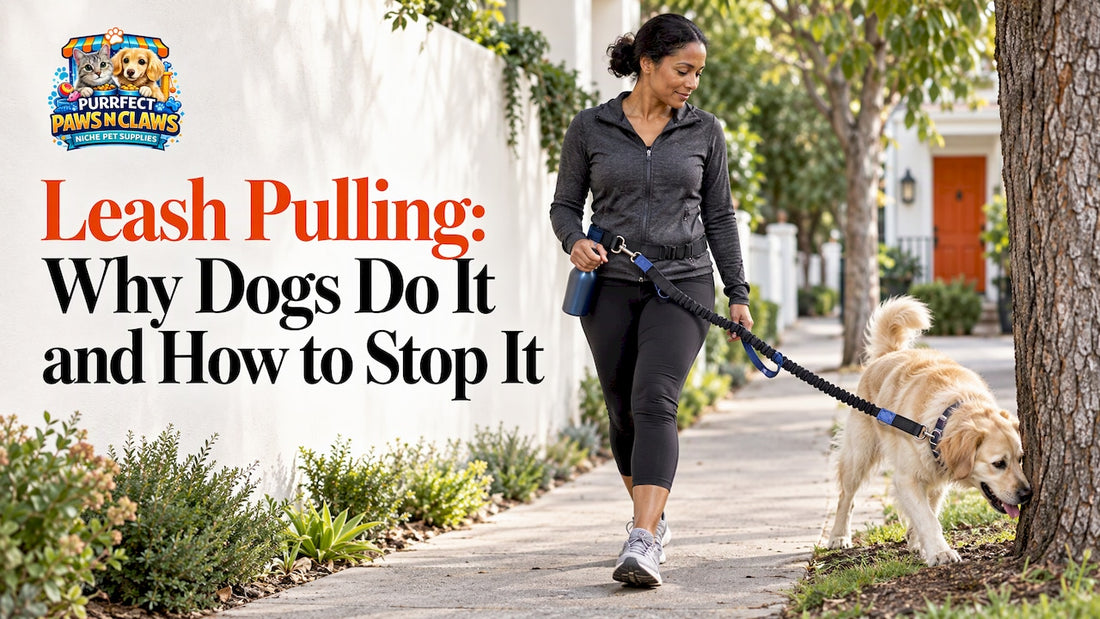
Your dog pulls because pulling works: every step forward on a tight leash gets them closer to where they want to be. The fix is to make a slack leash the only thing that moves the walk along, and to give your dog a leash and harness that fit well enough to make that practice comfortable for both of you. Below you’ll find why dogs pull, a step-by-step routine you can start in your living room, how to handle busy streets, and how to choose gear. We hand-select our dog supplies each month, so the walking gear at the end is a short list, not a wall of options.
TL;DR
- Dogs pull because it gets them where they want to go. Walking on while the leash is tight rewards the habit, so every walk you allow it makes it stronger.
- The core method: stop the moment the leash goes tight, wait for slack, then reward and move on. Consistency matters more than any gadget.
- Start training somewhere quiet, then add distractions gradually. Most dogs need several months of regular practice.
- Use a well-fitted harness or flat collar with a standard-length leash, and never jerk or pop the leash.
- If your dog lunges, growls or barks at people or dogs, that is a question for a behavior professional, not just a leash question.
Table of Contents
- Why your dog pulls on the leash
- The one rule: a tight leash means we stop
- A step-by-step routine for loose-leash walking
- What not to do
- Why your dog pulls more in some places
- Choosing and fitting walking gear
- Gear and enrichment from Purrfect Paws & Claws
- How long it takes, and how often to practice
- When pulling is more than pulling
- FAQ
- Sources
Why your dog pulls on the leash
Pulling is not stubbornness or dominance. It is a dog doing the sensible thing. According to VCA Animal Hospitals, dogs pull to get where they are going, they want to engage with their surroundings, and humans are slow from a dog’s point of view. Being tied to a person is also not natural for them, and many dogs lean into pressure on the collar instead of away from it.
There is a simple mechanical reason too. The Atlanta Humane Society points out that four paws almost always walk faster than two feet, and that a dog who feels pressure can engage muscles to push even harder into it.
The habit sticks because of how dogs learn. As AKC-certified trainer Stephanie Gibeault explains in the AKC’s expert advice, dogs repeat behaviors that earn rewards. If your dog pulls and you keep walking, the dog gets exactly the reward it was after, and the pulling gets worse over time. A single 30-minute walk with a dog pulling the whole way gives the habit thousands of repetitions.
Once you see it that way, the plan writes itself. Forward motion is the reward your dog wants. You are going to pay it out only for a loose leash.

The one rule: a tight leash means we stop
Every reputable method starts here. The AKC advice is to never walk while your dog is pulling. The moment the leash tightens:
- Stop and plant your feet.
- Wait for your dog to come back to you or ease the pressure.
- When the leash hangs in a loose J shape, praise, reward with a treat at your side and walk on.
The Asheville Humane Society adds a useful detail: hold the leash with both hands below your waist and anchor your hands against your body when it tightens, so you are a calm post, not a tug-of-war partner. Pulling back or continuing to walk on a tight leash teaches the dog that pulling gets results.
This only works if you do it every time. Best Friends Animal Society gives the math: if you stop four times out of five, the dog learns that pulling still sometimes gets it moving. Busy pet parents will find this the hardest part, because stopping every time feels slow. It is slow for the first few weeks, and that investment is what makes later walks quick and relaxed.
A step-by-step routine for loose-leash walking
This routine combines the approaches from VCA, the AKC, Best Friends and the Asheville Humane Society. Keep sessions short and end while your dog is still enjoying it.
Step 1: Set up for success
Pick a quiet room or a fenced yard. Use a leash about 4 to 6 feet long, as Best Friends suggests, and check that the collar or harness is snug enough that the dog cannot slip out, with room for a finger or two underneath. Use small, soft treats your dog loves. Exercising your dog or playing a short game beforehand helps too, because a dog with energy to burn has a harder time focusing. The Asheville Humane Society also suggests training when your dog is a little hungry so the treats are worth working for.
Step 2: Pay for attention and slack
In the quiet space, wait for even one second of slack in the leash. Say “Yes!”, give one or two treats, take a step or two, and repeat. VCA’s routine uses a treat held at your dog’s nose level in the beginning, delivering one every two to three seconds, and then adds a cue such as “Let’s Go!” so your dog learns it means “come with me.”
Where it goes wrong: over-prompting. Patricia McConnell warns in her guide to leash manners that if you keep calling and luring, your dog never learns to choose the right position on their own. Let your dog work it out, then reward.
Step 3: Make a tight leash boring
Practice the stop-and-wait rule indoors. When the leash tightens, stop. When your dog releases the pressure or turns toward you, mark it and reward. The San Diego Humane Society describes a game version: place something your dog wants just out of reach, wait until the leash has no tension, and only then let the game continue. Your dog quickly figures out that tension ends the fun and slack restarts it.
Step 4: Turn forward motion into the paycheck
Once your dog is getting it, change what you pay with. Treats at your side are great early on, but the AKC advises substituting treats with real-life rewards, like a sniff at a tree trunk, as the dog improves. Trainers at 3 Lost Dogs frame it neatly: the thing that reinforces pulling is forward motion, so use that same motion and sniffing as the payment for not pulling.

Step 5: Add distractions gradually
Move from living room to driveway, then to a quiet street, then busier ones. McConnell calls it a common mistake to go from kindergarten to graduate school in one step. If your dog cannot manage a new place, back up a level. A treat or toy placed 15 to 20 feet away, as the Asheville guide suggests, is a good bridge between indoor practice and real life.
Step 6: Take it on real walks
On real walks, keep the same rules. If your dog pulls toward something interesting, VCA advises standing still or taking a few steps away from it, waiting for any sign of a loose leash and rewarding quickly. If the dog cannot disengage, increase the distance and try again.
Some walks you will want to simply get somewhere. On those, a short “let’s go” and a brisk pace with plenty of treats works, and you can save the full stop-and-wait training for dedicated sessions.
What not to do
Leash corrections, meaning jerking or popping the leash or forcefully pulling the dog the other way, and pinch, prong or chain collars are discouraged by Best Friends Animal Society. They explain these methods can physically harm dogs, make pulling worse and aggravate problems like lunging at other dogs. The same goes for yanking the leash on any head-worn equipment: VCA warns that snapping or jerking the leash with a head halter on can cause neck injury.
Tension itself matters too. Dogs Trust, a UK charity, explains that a tight lead can unbalance a dog, make them feel trapped and intensify barking or lunging, and can change their body posture so they look defensive or aggressive even when they do not feel that way. A loose leash is better for your dog’s behavior as well as for your shoulder.
Why your dog pulls more in some places
If your dog heels nicely in the backyard and drags you down Main Street, that is normal. Dogs Trust explains that busy places can overwhelm a dog: crowds, noise, new scents, and the vulnerability of being small among large humans. Some dogs pull toward a safe space or away from something scary, and others are simply so excited to explore that focusing on you is hard.
A few things help:
- Burn off energy first. Dogs Trust suggests play or training before a walk.
- Change the route. Walking the same route in reverse or picking a new one makes the walk less predictable, so your dog pays more attention to you.
- Create distance early. Move away from the trigger before the pulling starts, not after.
Not all pulling is the same. A dog that pulls steadily out of habit or excitement still takes treats and responds to cues. A dog that suddenly stares, stiffens, speeds up or whines when another dog, bicycle or vehicle appears is reacting to a trigger, and USA Dog Behavior notes the leash can intensify that response by limiting the dog’s choices. When a dog is that aroused, familiar cues seem to vanish, and creating distance before the barking or lunging starts works better than repeating commands.
If your dog is a breed developed to pull, such as sled, working or tracking dogs, expect loose-leash walking to take extra patience, according to UC Davis School of Veterinary Medicine.
Choosing and fitting walking gear
Gear does not teach your dog anything by itself, but the right fit makes training safer and more comfortable. Here is what VCA recommends:
- Leash length: a 6 to 10 foot (1.8 to 3 m) leash that is wide enough to prevent friction burns if the dog pulls, yet light enough for the dog. For sniffing and exploring, a fixed-length long line of 15 to 50 feet works in open areas.
- Flat collar: two to four fingers of space under it. VCA notes it is not the right choice for hard pullers or dogs that cough when they pull.
- Harness: a well-fitted H- or Y-style harness with no straps across the front of the shoulder joints, no chafing and good escape resistance. Two clip points, one at the back and one at the front, give you options.
Fit matters as much as style. Check the straps after your dog has been moving, since a harness that looks right standing still can rub or shift on a walk. Reflective gear is worth having for dusk walks, which come early in November and December.
Our walking gear includes a nylon pet harness and leash set for a matched pair, a plain reflective dog leash, and an elastic reflective leash for running. If you prefer a collar, we also carry a dog belt collar for medium and large dogs. You can also browse dog training supplies, leashes and chest straps.
Gear and enrichment from Purrfect Paws & Claws
We hand-select dog and cat essentials each month, so you get practical choices without scrolling through hundreds of near-identical leashes. For loose-leash training, that means a short list of walking gear, from harness and leash sets to reflective leashes, plus toys and enrichment to use up energy before you head out. Orders over $50 ship free, so a harness, a leash and a few training toys can go in one order.

Browse the full range of dog supplies and walking gear and pick the leash and fit that suit your dog’s size and your walking routes.
How long it takes, and how often to practice
Expect weeks to see real change and months to make it reliable. VCA says most dogs need several months of regular practice to learn to walk on a loose leash, and that whole books, online courses and courses running eight weeks or longer exist just for leash walking. Short daily sessions of a few minutes beat one long weekly session. Fold the practice into the walks you already take: every doorway, curb and street corner is a chance to reward slack.
Because pulling is reinforced for every second a dog gets away with it, a family where one person lets the dog pull will undo the work of the person who does not. Agree on the rules together.
When pulling is more than pulling
Seek qualified help if your dog barks, growls, lunges, bites the leash or handler, has a bite history, reacts strongly to people or dogs, or is physically hard to control, as USA Dog Behavior advises. A behavior professional can separate a leash-training problem from fear, anxiety, frustration or aggression. UC Davis adds that dogs showing fear, anxiety or aggression need assessment by a veterinary behaviorist, with those issues addressed before loose-leash training. If you notice pain, a sudden change in your dog’s walking, or coughing when pulling, mention it to your veterinarian.
FAQ
Why is my dog pulling on the leash?
Because it works. Dogs move faster than people, they want to explore, and walking on a tight leash rewards them with exactly what they were after. Many dogs also lean into collar pressure by instinct. Changing what earns forward motion changes the behavior.
How do I stop my dog from pulling on walks?
Stop the moment the leash tightens, wait for slack, then reward and continue. Start in a quiet place, use treats at your side, and add distractions gradually. Be consistent, because even occasional pulling that pays off keeps the habit alive.
What type of leash is best for a dog that pulls?
A standard leash of 6 to 10 feet, wide enough to prevent friction burns but light enough for your dog, used with a well-fitted harness or flat collar. Our harness and leash sets and reflective leashes are available on our site. The training routine matters more than the equipment.
Should I jerk the leash or use a prong collar?
No. Best Friends Animal Society says leash corrections and pinch or chain collars can physically harm dogs, worsen pulling and aggravate behavior problems like lunging. Reward slack and stop when the leash is tight instead.
Sources
- Controlling Pulling on Walks, VCA Animal Hospitals
- Head Halter Training for Dogs, VCA Animal Hospitals
- How to Stop Your Dog From Pulling on Leash, AKC
- Preventing Leash Pulling, Atlanta Humane Society
- Stop a Dog From Pulling on Leash, Best Friends Animal Society
- Walking Nicely on Leash, Asheville Humane Society
- Training Tips: Loose Leash Walking, San Diego Humane Society
- Making Leash Manners Fun for Your Dog, Patricia McConnell
- Why Dogs Pull on the Lead and How to Help, Dogs Trust
- Why Does My Dog Pull on the Leash? USA Dog Behavior
- Loose Leash Walking, UC Davis School of Veterinary Medicine
- Does Your Dog Pull on Leash? A Step-by-Step Guide, 3 Lost Dogs